When records are easy to find and kept up to date, board members can make decisions with greater confidence and spend less time searching for information.
Why It Matters
HOA record keeping may not be the most exciting part of running a community, but it is one of the most important. Good records give boards a clear history of decisions, finances, projects, and communications while helping the association stay organized and prepared.
An HOA handles a steady flow of information throughout the year. Board meeting minutes, financial reports, vendor contracts, insurance documents, maintenance records, owner correspondence, and governing documents all become part of the association’s history.
Without a reliable record keeping system, important information can quickly become scattered. One document may be saved on a board member’s computer, another may be sitting in an email inbox, and an older contract may still be stored in a filing cabinet.
Good HOA record keeping creates one reliable place for the community’s information. It also gives future board members the background they need when leadership changes.
Records can also help explain why a decision was made. A board may need to revisit a landscaping contract, review an old repair, confirm an insurance policy, or understand how a previous assessment was approved. A clear paper trail makes these tasks much easier.
For communities in Massachusetts, record keeping also has a legal component. Massachusetts General Laws Chapter 183A requires condominium organizations to maintain certain governing, meeting, financial, contract, and insurance records. The law also provides for inspection rights and requires covered records to be retained for at least seven years.
What Records Should an HOA Keep?

There is no single folder that can hold everything an association may need. A practical record keeping system should separate documents by purpose so that board members and management can find information without digging through hundreds of unrelated files.
At a minimum, communities should maintain records in several key areas.
Governing Documents
The association’s governing documents form the foundation of the community. These documents explain how the association operates, what the board can do, and what owners are expected to follow.
Important documents may include:
- Declaration, master deed, or condominium documents
- Bylaws
- Articles of incorporation, when applicable
- Rules and regulations
- Amendments
- Architectural guidelines
- Policies adopted by the board
- Recorded plans and related documents
These documents should be kept together and updated whenever an amendment is approved or a new policy is adopted. Older versions should not simply disappear, either. Keeping a clear history can help show when a change took place.
Massachusetts guidance specifically identifies the master deed, bylaws and amendments, and association minute book among the records that should be maintained for condominiums.
Board Meeting Records
Board meetings are where many of the association’s most important decisions are made. The minutes should provide a clear record of what was discussed and what action was taken.
Good meeting records do not need to capture every word spoken during a meeting. They should clearly document the date, attendees, important motions, votes, approvals, and other actions that need to be remembered.
Meeting materials can also be retained with the minutes. This might include financial reports, proposals, contracts, project information, or other documents reviewed by the board.
When a new board takes over, these records become especially valuable. Instead of starting from scratch, new directors can review the association’s past decisions and understand what is already underway.
Financial Records
Financial records deserve special attention because they show how the association is managing community funds.
A well-organized financial file may include:
- Monthly financial statements
- Bank statements
- General ledgers
- Accounts payable records
- Accounts receivable records
- Invoices and payment records
- Assessment records
- Reserve fund records
- Budgets
- Financial reviews or audits
- Tax documents
- Vendor payment records
Massachusetts condominium law specifically lists receipts and expenditures, invoices, vouchers, receivables, bank statements, reserve fund records, financial reports, contracts, and insurance policies among required financial records.
Keeping financial records organized also makes year-end reporting and work with the association’s accountant much easier. When supporting documents are already in order, fewer questions need to be answered later.
Vendor and Contract Records
HOAs often work with landscapers, contractors, maintenance companies, insurance providers, attorneys, accountants, and other vendors. Each relationship creates records that should be maintained throughout the life of the contract.
A vendor file should generally include the signed agreement, scope of work, pricing information, insurance certificates, renewal dates, invoices, and important correspondence.
It is also helpful to keep track of when contracts expire. A board should not have to discover an automatic renewal after the renewal date has already passed.
Contracts can also help future boards understand why a vendor was selected and what services the association is paying for. This is particularly useful when a major project continues across several board terms.
For Massachusetts condominiums, contracts for work or services provided to the organization are among the financial records identified under Chapter 183A.
Maintenance and Property Records

Maintenance records tell the story of the physical community. They can show when equipment was serviced, which repairs were completed, what problems have occurred, and how much the association has spent on certain assets.
These records become especially useful when the board is planning a large repair or deciding whether an asset should be repaired or replaced.
For example, a community may have repeated issues with a roof, drainage system, pavement, HVAC equipment, or irrigation system. Looking at past work orders and invoices can help the board see whether the problem is a one-time issue or part of a larger pattern.
A useful maintenance file can include:
- Work orders and service requests
- Contractor proposals and estimates
- Invoices
- Inspection reports
- Warranty information
- Maintenance schedules
- Project photographs
- Completion records
Photos can be particularly helpful for projects involving exterior areas. A simple before-and-after record can provide useful documentation years after the work has been completed.
Owner and Community Records
Associations also manage information connected to individual homeowners and the community as a whole. This can include owner contact information, architectural requests, violation notices, correspondence, applications, and other association-related documents.
These records should be handled carefully. Not every document belongs in a general community folder, and sensitive information should not be accessible to everyone who has access to association files.
A good system separates general community records from confidential or restricted information. Access should be based on a person’s role and responsibilities.
Boards should also avoid keeping unnecessary personal information. The goal is to maintain the information the association actually needs while protecting homeowner privacy.
Digital Records and File Organization

Many HOAs have moved away from paper-heavy filing systems, and for good reason. Digital records can be searched, shared, backed up, and accessed more easily when they are organized correctly.
The problem is that digital storage can become just as messy as a filing cabinet.
A folder named “HOA Documents” does not help much if it contains thousands of files with names such as “IMG_2387,” “scan001,” or “finalfinal2.” A consistent structure makes a major difference.
A community might organize its digital records using folders such as:
- 01 Governing Documents
- 02 Board Meetings
- 03 Financial
- 04 Owners
- 05 Vendors and Contracts
- 06 Maintenance
- 07 Insurance
- 08 Projects
- 09 Legal and Compliance
- 10 Historical Records
The exact structure can be adjusted to fit the community. What matters most is consistency.
File names should also make sense at a glance. Instead of saving a document as “invoice.pdf,” a better name might be “ABC Landscaping Invoice June 2026.pdf.” This small change can save a surprising amount of time later.
Protecting HOA Records
Keeping records is only part of the job. The association also needs to protect them.
Important documents should be backed up regularly and stored in a secure system. Access should be limited to people who need the information to perform their duties.
Boards should also think about what happens when a director leaves. If association records are stored on a personal computer, personal email account, or private cloud drive, the community may have difficulty recovering them.
This is one reason centralized record storage is so important. Association records belong to the association, not to an individual board member.
Massachusetts law addresses this point for condominium associations by stating that records maintained by a manager or managing agent are the property of the organization. When management ends, the manager or managing agent is required to provide the association with the books, records, funds, and accounts in its possession.
How Boards Can Improve Record Keeping
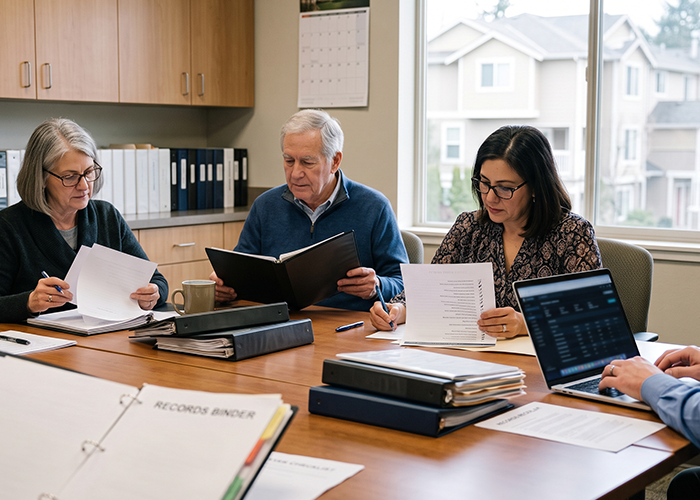
A board does not need to create a complicated system to improve its records. In many cases, a few consistent habits can make a noticeable difference.
Start by reviewing what the association already has. Old records should be sorted, duplicates identified, and important documents moved into a consistent folder structure.
Next, establish simple rules for new documents. Decide where meeting minutes will be saved, where invoices will go, how contracts will be named, and who is responsible for maintaining each category.
It is also helpful to review the records periodically rather than waiting until there is an urgent need for something.
A simple annual records review can help the board:
- Confirm that governing documents are current.
- Check that contracts and insurance policies are on file.
- Confirm that financial records are complete.
- Review meeting minutes for missing documentation.
- Remove duplicate or unnecessary files.
- Verify that backups are working.
- Confirm that access permissions are still appropriate.
The process does not need to take over the board’s schedule. A little maintenance throughout the year is usually easier than trying to reconstruct years of missing records.
Record Keeping During Board Transitions
Board turnover is one of the times when good records matter most.
New directors should not have to rely on verbal explanations from outgoing board members to understand the association. They should be able to review the governing documents, financial information, contracts, meeting minutes, ongoing projects, and other important records themselves.
A transition package can make this process much easier. It can include current board information, management contacts, vendor details, upcoming contract renewals, ongoing projects, financial reports, and key community policies.
This also reduces the risk of losing institutional knowledge. Board members change, but the community continues.
Good Records Today Protect Your Community Tomorrow

Good HOA record keeping often goes unnoticed when everything is running smoothly.
Its value becomes clear when a board needs to answer a question, review an old decision, prepare for an audit, change management companies, handle a major project, or welcome a new group of directors.
Disorganized records can slow your board down and put important decisions at risk. Harbour Master Management Group helps HOA boards build reliable systems for managing documents, finances, contracts, and daily operations so nothing falls through the cracks. Call 401-414-5130 or contact us online to get started.
Related Articles:
- Better HOA Board Meetings: Proven Ways to Improve Productivity and Decision-Making
- Cost Management in HOAs: Smart Strategies to Control Community Expenses
- Breaking Down HOA Fees and Where the Money Really Goes